Pages

Search This Blog

Showing posts with label Thriving in the Digital Age. Show all posts

Tuesday, January 14, 2014

What Does Charisma Have to Do with Learning?

"Charisma has nothing to do with energy; it comes from a clarity of WHY, an undying belief in a purpose or cause." —Simon Sinek
When I put Start with Why on the reading list for Thriving in the Digital Age, it was because I wanted to encourage the kids in my class to think deeply about leadership. Specifically:
  • What exactly do we look for in a leader? 
  • What type of person inspires us to act—and why? 
  • What qualities would we, personally, like to develop in ourselves to become stronger leaders?;
  • How might we inspire others to follow our lead (for example, if we wanted to convince others to actively support a cause we felt was important)?
In his book, Start with Why, Simon Sinek argues that "energy excites" and "charisma inspires." To illustrate his point, he compares Microsoft CEOs Bill Gates and Steve Ballmer.


Gates isn't a very energetic speaker, yet he inspires people to follow his lead. Sinek says this is because Gates is optimistic and devoted to what he believes in. Presumably, he has that elusive and hard-to-define quality known as charisma. In contrast, Ballmer can stir up a crowd with his high-energy performances but, according to Sinek, he is not likely to inspire enduring loyalty, because:
"Only charisma can inspire."
While I agree that charismatic people do tend to attract devoted followers or "true believers," something about the exclusivity of Sinek's claim doesn't sit right with me. Was Sinek implying that those of us who lack charisma are incapable of inspiring, destined to become followers? I couldn't accept this conclusion, and I was curious to see how the teens in my class would react. Would they agree with Sinek? If so, how would they describe their own levels of charisma or, more importantly, their chances of becoming inspirational leaders?

What Do We Look for in a Leader?
As we talked about the people whom Sinek describes in his book—Martin Luther King, Bill Gates, Steve Jobs, Herb Kelleher (founder of Southwest Airlines), and several others—we considered what we felt were important leadership qualities. The students said they valued honesty and being able to communicate effectively, because "No one will follow you if they can't trust you or if they don't know what you're talking about." Talent, passion, vision, integrity, commitment, and empathy were also added to the list.

What Type of Person Inspires Us to Act—and Why?
Responding to the question about who inspires them, the students considered the power of commanding rhetoric (e.g., Obama's speeches), the limited effectiveness of reward systems (especially as sources of inspiration), and the extraordinary impact of impassioned, transformational leaders, such as Malala Yousafszai.


Do We Need to Have Charisma to Be Leaders?
When our discussion turned to the subject of charisma, I asked the group, "If charisma comes from 'an undying belief in a purpose or cause'—as Sinek claims—do we all have the potential to be charismatic?"

The responses I got from the students were insightful, and I'd like to share some of what I learned from them here. One student surprised me by quoting Lawrence of Arabia in his reflection:
"It's always been my view that leaders are not people with a Why, or people with a driving motivation. I mean, of course they have those but so does everyone else. What makes leaders unique is their ability to bring their Why's into reality. In other words, I agree with this quote from T. E. Lawrence (also known as Lawrence of Arabia), 'All men dream: but not equally. Those who dream by night in the dusty recesses of their minds wake in the day to find that it was vanity: but the dreamers of the day are dangerous men, for they may act their dreams with open eyes, to make it possible.'"
This student went on to explain that he interpreted Lawrence's use of the word "dangerous" in a positive way, as meaning "adventurous" or "disruptive to the status quo." He also made another observation worth sharing here:
"Everyone has some greater driving motivation as to why they do what they do, and everyone has something that they are passionate about. We don't need other people to give us a why; we want someone to help us realize our own why."
I imagine all students saying this to their teachers. "We aren't asking you to tell us who we should be (whether it's interested in Subject X, aiming for College Y, or preparing for Career Z); we are asking you to help us discover who we already are."

Another student, a young woman who is passionate about music and theater, talked about what it means for a performer to have charisma. She recalled with enthusiasm an article from the New York Times ("A Gift from the Musical Gods" by Zachary Woolfe), which asks the question, "How is a performer a leader?" Woolfe writes:
"To experience a charismatic performance is to feel elevated, simultaneously dazed and focused, galvanized and enlarged. It is to surrender to something raw and elemental, to feel happy but also unsatisfied. Charisma calls forth a melancholy, a vaguely unrequited feeling. I’ve caught myself, after certain performances of an aria or a movement, leaning forward, as if drawn against my will. . . . Charisma requires that you acknowledge a new, larger set of possibilities."
So, not unlike leaders in other fields, charismatic performers inspire people to stretch and reach for loftier goals than they would otherwise. Unfortunately, according to Woolfe, "Rigorous training enhances and focuses [charisma], but it cannot create it." So, either you've got it—or you don't.

The young students in my class seemed to agree, saying,"People can know their why, but perhaps not have charisma, or vice versa . . . charisma isn't something that can be taught—one is born with it." However, one student described Sinek's definition of charisma (as a "clarity of WHY") as "half-true,"noting that:
http://www.npr.org/templates/story/story.php?storyId=123612228
Maria Callas, EMI Classics
"Charisma is strengthened when the leader or performer knows what their WHY is. For an actor especially: if they haven't asked 'Why?' to each and every line and aspect of the character's notions, it won't be a truthful performance—and even if the performer has the god-given talent of charisma, their performance will lack relevance and the strength to hold the audience's attention. And the same goes for other great leaders. Being able to harness both natural talent and 'the clarity of WHY' together is what leads to a very successful performance."
The same student also argued that an opera singer like Maria Callas is successful not only because she is naturally charismatic but also because she has a clarity of purpose, a genuine passion, that comes across in performances.

So, What Does Charisma Have to Do with Learning?
No matter what we do, whether we are incredibly charismatic or less so, it seems our success—as leaders or followers—is enhanced if we have a clear sense of who we are and what drives us.
This is why I feel it is vital for a student's education to be a process of self-discovery. Returning to Woolfe's article, I'm drawn to the following observation:
"What we generally consider the 'content' of the arts — the notes, the libretto, the bowings, the plot — is actually just the structure that makes possible the crucial thing: watching a performer who is able to connect with fundamental realities. It is not that a singer’s charisma makes a colorful aria sound even better but that the aria provides a platform, a vessel, for us to experience the charisma."
Would it be possible to think of learning in a similar way?
"What we generally consider the 'content' of education — the curricula, the scope and sequence, the technologies, the projects and activities — is actually just the structure that makes possible the crucial thing: helping a learner connect with the fundamental reality of who he or she really is. It is not that a student's aptitudes enable him or her to perform well in class but that the class provides a platform, a vessel, for every student to experience who they truly are."
What do you think?

Thursday, January 2, 2014

Identity, Motivation, and Purpose: An Update on Thriving in the Digital Age

In the course I'm teaching, Thriving in the Digital Age, I seem to be learning and growing as much as my students. As I listen to them struggle to articulate how they feel and think about complex topics, such as identity, motivation, and purpose, I'm often forced to re-evaluate my own assumptions regarding these subjects. It's an extraordinary opportunity: how often do we, as adults, set aside time to think deliberately about our personal and social identities, about all the ways in which various internal and external motivators influence our actions, or exactly how our unconscious values might be directing our lives? These teens, in contrast, are profoundly and constantly aware of these things, and they are helping me to become more aware of them, too.

What I would like to do here is to share some of the materials we've used so far for the course. (For a more complete listing, refer to the Weekly TED Talks and Online Resources posted on the course website.)

We began the course with the book Quiet by Susan Cain . . .


I paired Quiet with Chapter 1 ("Attention! How and Why to Control Your Mind's Most Powerful Instrument") of Net Smart by Howard Rheingold, and this seemed to work out very well. We talked about introverts, extroverts and how to deal effectively with distractions in an "always on" world. We discovered that "distractions" can be a problem for introverts as well as extroverts but not in the same way. The extroverted students sought ways to control their multitasking habits—they loved all that stimulation and found it hard to stop—so they needed help focusing their attention. Meditation was a good addition to their tool set. The introverted students weren't attracted to multitasking; they preferred to do one thing at a time. What they craved was less stimulation, fewer interruptions, so they needed to find ways to access the digital world without becoming overwhelmed by it. The tools that were most helpful to them were dashboards and filters, which controlled the flow of information, and online discussion forums, where they could take as much time as they needed to compose and share their thoughts.

Next, we moved on to Being Wrong by Kathryn Schulz . . .


The logical pairing for Schulz's book was Chapter 2 ("Crap Detection) of Net Smart. We talked about why we get things wrong, how it feels to be wrong, and what can be gained from learning to embrace our fallibility. Topics of discussion included "filter bubbles" and why it's important to consult a variety of reliable sources; optical illusions, phantom limbs and other errors in perception; internet hoaxes and other scams; the Enlightenment, the Scientific Revolution, and the ways in which changes in cultural attitudes toward error have transformed science and industry; forensic psychology and how people in general and eyewitnesses in particular sometimes get things wrong; neuroscience; cults; terminal illness and the stages of grief; and, as a recurring theme, how we feel about being wrong and why it's so hard to let go of our desire to be right.

Currently, we are reading Start with Why by Simon Sinek . . .


I'm combining this with Chapter 5 ("Social Has a Shape") of Net Smart by Howard Rheingold and selections from Connected by Dr. Nicholas Christakis. The primary themes for these four weeks of the course are leadership and social networks, but we're also exploring the connections between the two. How do good leaders participate in social networks? Or, conversely, how do our social networks—or lack thereof—influence our ability to become effective leaders?

So far, I've supplemented the primary readings with talks by:
These presenters have inspired interesting and sometimes heated discussions. For example, we've debated the differences—sometimes subtle, other times extreme—between motivation and manipulation, particularly when it comes to marketing. Is it the message, the product, or the image of ourselves that influences our choices? We've also questioned the relative merits of "vision" and pragmatism, the pros and cons of going after a dream versus doing a job that simply needs to get done. Where one student emphasized practicality and argued the importance of quality control (the HOW and WHAT of a job), another admired leaders who could articulate a higher purpose for mankind (the WHY of a movement).

I'm looking forward to continuing this course in the months ahead and plan to share in future posts more of what I'm learning from the students. 

Sunday, October 20, 2013

Thriving in a Hybrid Course

When I began this year with plans to teach a course on "Thriving in the Digital Age" (for details, see my earlier post), I wasn't sure how well it would work. Would I be able to create a hybrid course, a combination of digital and face-to-face learning?

(A little background: For the past five years, I've been co-teaching courses designed for a small group of homeschooled students. The actual composition of the group has changed slightly over the years as families have come and gone, but the format has stayed pretty much the same: with two parents as co-teachers, we've organized weekly discussions, student presentations, and team debates. In between classes, students have worked mostly on their own or in pairs. The only online portions were the websites, which I created for posting assignments and other course information. The students checked the websites perhaps once a week.)

Wednesday, July 31, 2013

Are You Drinking Water From a Firehose, or Casting a Line Into a Stream?

As part of my research for a high school course on "Thriving in the Digital Age" (course website), I have been reading Net Smart: How to Thrive Online by Howard Rheingold. In Chapter 2, he writes, "The real-time Web is not a queue . . . but rather a stream. Don't even try to keep up. Learn to sample." He goes on to describe techniques for sampling, by "tuning your antennae for the right signals" and "bringing the right information to you."

I felt a sense of relief as I read this. For weeks, I had been struggling to assess the overwhelming variety of Web 2.0 social media tools. Naively, I was trying to review every tool and learn everything there was to know, and I felt like I was drowning in a sea of information. "So," I thought to myself, "this is why people frequently compare using social media to drinking water from a fire hose." I needed a new approach, and Rheingold's mention of a stream opened my eyes to a different (though still watery) metaphor.

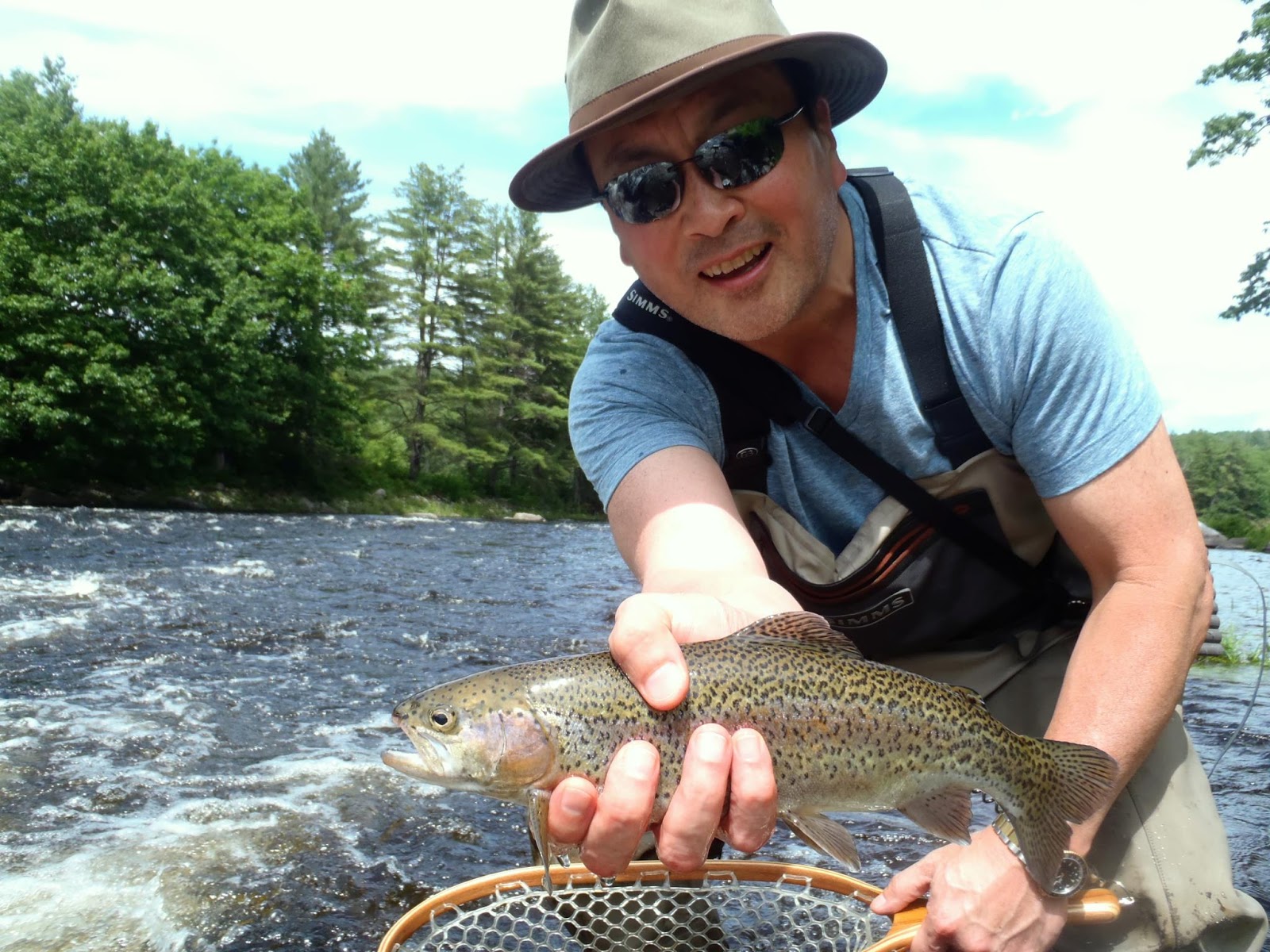
 I began to picture a beautiful stream, beckoning to me, inviting me to cast a line into the water. I thought about my husband, an avid fly fisherman, and how relaxing it is to watch him practice his art. The graceful motions inspire feelings of patience, serenity, inner calm and, on a lucky day, the thrill of the catch. It's not at all like the image of a fire hose, which I associate with scary, high adrenaline experiences: buildings in flames, mobs out of control, intense pressure and violent release. I would prefer my experiences in the online world to be more like catching fish than catching hell. I'm looking for quality, not quantity.

Rheingold writes about the importance of mindfulness when we use technology. To avoid unnecessary distractions, it helps to decide in advance what we hope to achieve in a given day, or year, or lifetime. Sure, those pictures of kittens are really adorable, but how much time do we want to devote to them? When, where, and how do we want to focus our attention? Ideally, online tools should help us to filter, organize, and limit the content that fills up our screens and lives. Used wisely, they can be as useful to us as the right fishing lure is to a fisherman.

An article from Steffan Antonas, "Drinking from the Social Media Firehouse—Six Lessons Learned," offers sage advice on how to use social media in a sane and meaningful way. He reminds us that "Social media interactions are meaningful only if you’re sharing remarkable ideas, being memorable, helping people achieve their goals, connecting to people and (most importantly) converting those connections into real offline relationships."

Obviously, we have to be selective about what we consume and create. The question is: do we want to be the ones doing the selecting, casting our lines strategically, or are we content to wait and see what hits us in the face at random? When I take time to learn how to tailor an RSS feed, set up a dashboard, or use tags and keywords to filter news reports, I feel it's time well spent. Like an experienced fisherman selecting the right lure, I can increase my chances of hooking something of interest while allowing everything else to flow past. Of course, I won't catch everything, but that doesn't need to be the goal for the experience to be rewarding.

Monday, July 8, 2013

Thriving in the Digital Age

I've fallen behind on my postings but have been working steadily on plans for the course I described in earlier posts. The website for the course, Thriving in the Digital Age, is now available for browsing! Although the course is still a work in progress, most of the overall framework is solid at this point.

I've made some changes to my original plans. In Building on TED Talks: A Course for High School Seniors (Part I), I identified four tentative themes for grouping the talks and readings:

  1. How We Think About Ourselves
  2. How We Think About and Use Technology
  3. How We Relate to One Another
  4. How We Offer to Help Those Who Need It
I've since changed the themes for the course slightly to suit the needs of the students who will be participating. After discovering that one of my students was planning to take a college course on Global Social Issues this fall, I decided that much of what I had in mind for the fourth theme ("How We Offer to Help Those Who Need It," which included TED talks and related books by Jacqueline Novogratz, Dan Pallotta, Paul Collier, and Melinda Gates) would be too redundant. In a way, this was a relief to me: I was already worried that the focus of the course was too broad, and I was searching for a way to narrow it. Also, two of the books I was considering—The Bottom Billion by Collier, Charity Case by Pallotta—seemed as though they might not be a good fit for a few of my other students. 

So, I set aside the fourth theme, did some reorganizing, and ended up with the following themes instead: 
  1. Empowerment, Personal and Political. What makes us feel empowered (or disempowered)? What types of situations or social conditions encourage more people to participate (online, face-to-face, at work, in our communities, or in general)? How does the internet influence who participates—and how and why do people feel empowered to do so? Why are some people effective leaders, able to motivate people to get involved, while others are not? (This theme is essentially a combination of "How We Think About Ourselves" and "How We Relate to One Another" from my initial planning phase, described above.)
  2. Harnessing the Power of Distributed Expertise—How can we optimize our use of massive amounts of aggregated data and collective human brainpower? Major topics include Wikis, gaming, crowd sourcing, hive mind, and "cognitive surplus" (a term coined by Clay Shirky). The emphasis here is on intellectual collaboration.
  3. Using Technology Mindfully for Sharing and Collaboration—How is technology changing the way our society functions, or how we are meant to coexist within our society? How might it alter the way we acquire, use and dispose of our "stuff"? Major concepts to be discussed include collaborative consumption, sustainability, open source, and (time permitting) "Sensible Cities." The emphasis here is on economic collaboration.
To explore these themes, I've found wonderful TED Talks and RSA Animates (posted on the Videos page), books (listed in the Syllabus), and websites. I'm excited about the idea of using student and class blogs to encourage discussions outside our weekly class meetings, so I've also added a page on Blogging. And, inspired by Howard Rheingold's admonishments to use technology mindfully, I've recently added a light-hearted page on Procrastination (with links to TED Talks by Vik Nithy, who offers advice on how to stay on task, and Dave Windass, who extols the merits of procrastinating). 

Currently, I'm working on developing ideas for class discussions and projects. I'll post more on those later.