Pages

Search This Blog

Friday, December 20, 2013

Origami Connects More Than Pieces of Paper

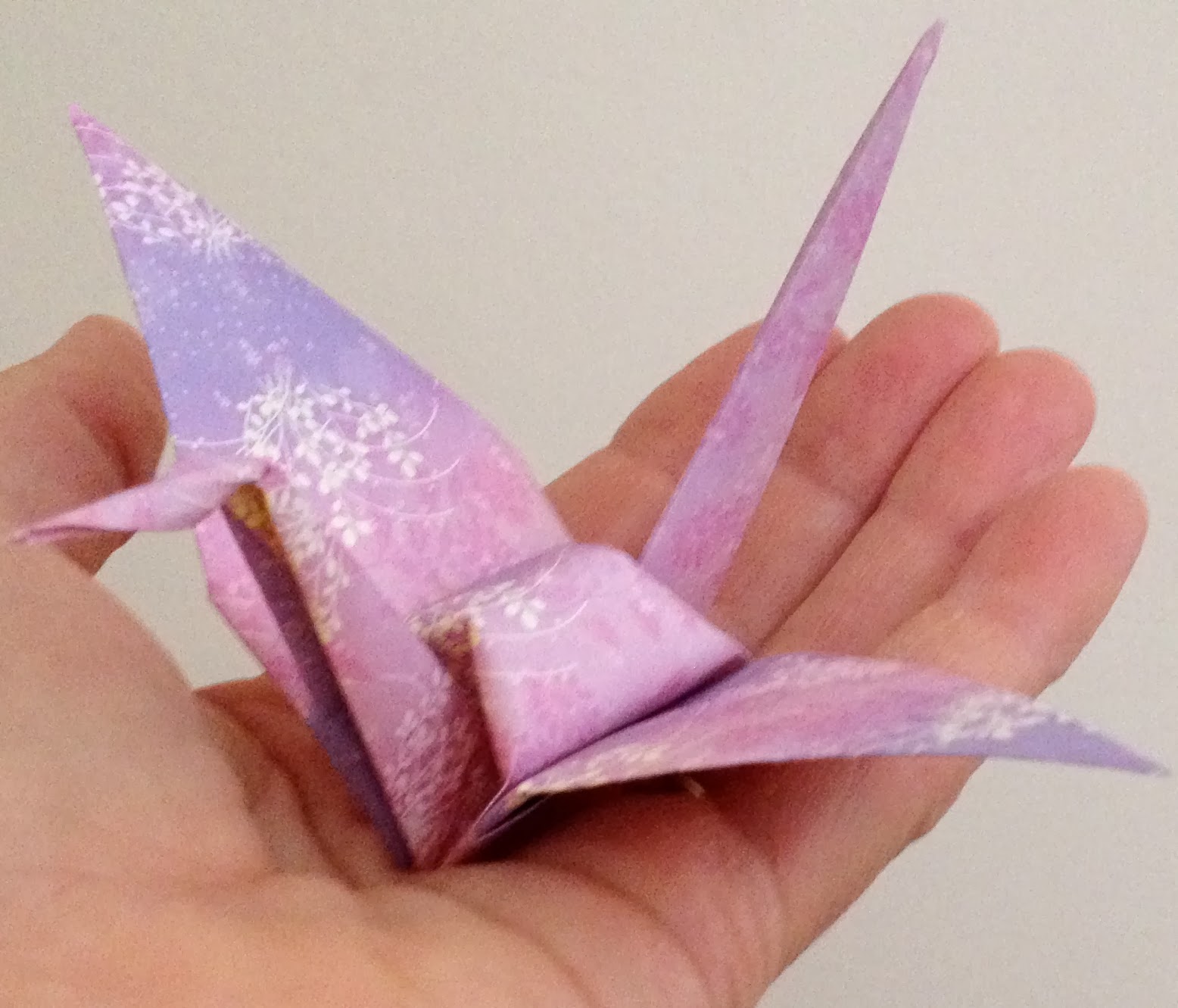
The first homeschooler I ever met was an avid origami enthusiast. I've no idea how many kids learned the art of paper folding from Mileva, but I imagine there must have been hundreds. She taught her own kids who, when they were old enough, ventured into the public schools and shared their craft with others. My kids and I learned how to fold simple origami boxes under her tutelage, and we in turn taught our friends. Even though the results weren't always worth saving, we enjoyed losing ourselves in the meditative practice, focusing intently on sharp creases and perfectly aligned edges.

Mileva introduced us to Origami USA, a national society devoted to origami. Although I originally contacted them to get bulk rates on origami paper—necessary when your kids are going through stacks of the stuff—I also appreciated the informational resources and sense of community they fostered. Discovering fellow enthusiasts was part of the fun. While we were studying the diagrams and feeling mystified by the instructions (often written in Japanese), we thought about our relatives in Japan and the Japanese friends we had made through the Labo International Exchange Program.

I have fond memories of a wonderful, sunny afternoon spent in the company of an elderly woman at an event hosted by the Japanese American Citizens League (JACL). The unassuming woman sat at a table and quietly demonstrated fold-after-fold to a steady stream of visitors. Young and old learned how to create beautiful stellated octahedrons (12 pieces of paper; pictured right) and icosahedrons (30 pieces of paper). These projects, which seemed impossible to us at first, quickly grew into a habit-forming routine—all thanks to this lovely demonstrator. We filled our house with polyhedrons.

I'm sure Mileva, a brilliant woman with an aptitude for mathematics, used various origami lessons to teach her children about geometry. Rectangles, triangles, parallel lines, right angles—it was all there, somewhere, in the art of paper folding. While her explanations of math through origami might not have impressed someone like Robert Lang (TED Talk: "The Math and Magic of Origami;" website: Origami Mathematics), her creativity and enthusiasm inspired many fans. My kids and I were among them.

Unlike Mileva, I didn't use origami explicitly for math instruction. However, I suspect origami nurtured my kids' natural interest in patterns and connections: if they could take a two-dimensional sheet of paper and turn it into a three-dimensional object, what else might be possible? Origami fostered their ability to visualize a shift from 2D to 3D, which in turn seemed to ease their later studies of molecular structures, fractals, and chaotic systems. Skills such as tenacity and attention to detail—essential for success at origami—also happened to be quite useful for math—and life.

Origami is a good metaphor for the way we learn as homeschoolers. It's something we can do alone or with others. It appeals to us artistically, intellectually, and practically. We respond to the challenge with a desire for mastery and understanding, and we devote ourselves to the task. When our first attempt is unsuccessful, we try again or from a different angle. If we get stuck, we consult books or experts or online tutorials. And, sometimes, we just have to feel our way around and hope for the best as we nudge pieces gently into place.

There are many things worth doing, but we can't always see the value in advance. Sometimes, we have to trust what feels right, give in to our creative impulses, and avoid worrying excessively about outcomes or assessments.

Origami Resources
Interested in learning origami? Check out Origami Spirit (includes YouTube tutorials) by Leyla Torres. She recently posted "Twelve Lists of Top-Notch Origami Video Tutorials." Her videos range from simple to complex, and her enthusiasm for origami is contagious.

For anyone who would like to learn how to fold a simple, modular origami "ball," I found these helpful instructions by TheZocar on YouTube:


Friday, December 6, 2013

Can a Class Be Too Small?

In his book, David and Goliath: Underdogs, Misfits, and the Art of Battling Giants, Malcolm Gladwell opens a can of worms when he asks the question, "Can a class be too small?" When it comes to the number of students in a classroom, most of us assume smaller is better. I know I do. The low student-to-teacher ratio makes sense to me intuitively: the fewer students a teacher has in his or her class, the more individualized attention each student would receive.

And yet, Gladwell argues that "The small class is potentially as difficult for a teacher to manage as the very large class size." To test his theory, Gladwell polled a large number of teachers in the United States and Canada. In David and Goliath, he quotes some of those teachers as they offer plausible explanations for why small class sizes are problematic:
  • Interactions are too intense. While there are, presumably, fewer interactions in a small class for a teacher to manage, the interactions that do occur are more difficult to handle. "There is simply no way for the cantankerous kids to get away from one another." There's no place for students to hide. According to one teacher, "the students start acting 'like siblings in the backseat of a car.'
  • Insufficient "critical mass" for discussions and group activities. As a middle school teacher explains, "students are awkward and self-conscious and anxious about seeming too smart. Getting them to engage . . . can be 'like pulling teeth.'" Also, as one teacher states, "It's difficult to play games . . . the  momentum just isn't there.
  • Lack of peers at a similar academic level within a class.  In a really small class, it is harder to find others who are just like you. There are no subgroups. Complains one teacher, "The chances that children are surrounded by a critical mass of other people like them start to get really low." As one teacher explains: "What you need [as a student] is to have people around you asking the same questions, wrestling with the same issues, and worrying about the same things as you are, so that you feel a little less isolated and a little more normal.
  • Lack of diversity in discussions. Fewer students means fewer (if any!) participants in a discussion. If the group is too small, "it's like they have a muzzle on." 
The magic number for class size, according to the teachers Gladwell polled, seems to be between 18 and 30 students. Since I have trouble understanding why a teacher would actually prefer to work with so many students at one time, I would like to contrast my experiences as a homeschooler with the experiences of the teachers Gladwell interviewed. The main question I'm attempting to answer is this:
Exactly what is it about certain settings—in particular, the various discussion-based classes that are taught by homeschooling parents like myself—that makes small class sizes desirable?  
(Although my response is necessarily based on my experiences as a home educator, I imagine there are many other situations where small class sizes are preferable, too.)

Tuesday, November 5, 2013

Excuse My Absence: November Is National Novel Writing Month

For the past couple of years, I have set aside time during the month of November for National Novel Writing Month. Although I've yet to take my "novels" to the next stage to have them published, I have enjoyed the process immensely. One of the highlights of my years of home educating has been to participate in NaNoWriMo with my kids.

I have to thank my kids for this. They were the ones who discovered NaNoWriMo. When my oldest daughter was around 15 and an avid writer, she successfully completed the challenge: writing 50,000 words in 30 days. Her younger siblings, who were only nine and twelve at the time, entered the competition, too. Although they didn't reach the 50,000 word goal that first year, they got a taste for writing that stayed with them.

Sunday, October 27, 2013

Teens Reflect on Pros and Cons of Social Media Use

Recently, I asked a group of homeschooled teens to complete a questionnaire about how much time they spend using social media (texting, instant messaging, emailing, posting on Facebook, talking on Skype, gaming, and watching videos). Unlike the stereotypical teens I hear so much about, this group of adolescents did not seem particularly attached to their devices—I rarely saw them with a phone in their hands, for example—so I suspected they were less apt to engage in technologically-mediated conversations than their schooled peers. However, what I learned about their use and perception of social media surprised me.

Sunday, October 20, 2013

Thriving in a Hybrid Course

When I began this year with plans to teach a course on "Thriving in the Digital Age" (for details, see my earlier post), I wasn't sure how well it would work. Would I be able to create a hybrid course, a combination of digital and face-to-face learning?

(A little background: For the past five years, I've been co-teaching courses designed for a small group of homeschooled students. The actual composition of the group has changed slightly over the years as families have come and gone, but the format has stayed pretty much the same: with two parents as co-teachers, we've organized weekly discussions, student presentations, and team debates. In between classes, students have worked mostly on their own or in pairs. The only online portions were the websites, which I created for posting assignments and other course information. The students checked the websites perhaps once a week.)

Tuesday, October 1, 2013

The Testing Effect

Testing is a controversial subject. But, in spite of the controversy, kids who attend school are routinely tested and retested. They are quizzed, assessed, examined, graded and ranked in every grade and every subject. Given our cultural obsession with testing, it's almost inconceivable for teachers or administrators to think of education without also thinking of testing. It seems inescapable.

How did we ever become convinced that testing is the best way to ensure that learning takes place?

As a home educator, the idea of testing was foreign to me. I raised my kids from birth to age six without ever testing them, yet they learned to walk, talk, read, sing, dance, knit, bake, sew, write, and more. How is it possible that they could have mastered so many things without being tested on them? I don't know. They were curious; they learned. I tried not to interfere too much.

Wednesday, September 4, 2013

Building a Community

When I began homeschooling, back in 1997, I had no idea what it would be like. I knew only one other person whose children did not attend school, and she lived several towns away. During the week, my neighborhood seemed quiet and empty, as all my neighbors sent their kids to local public or private institutions. I tried to ignore the nervous feeling that threatened to erode my confidence. Was I going to go crazy at home? Would my children become isolated and strange?

How were we going to meet people and make friends if there was no one around?

School children singing, Pie Town, New Mexico  (LOC)
If my kids had attended school, their community would have been defined primarily by where they lived. In contrast, as I commuted to distant towns to meet with homeschoolers for group activities and field trips, I observed that town boundaries mattered far less to us than shared interests.

It seems we were part of a trend. A 2006 report from the Pew Internet and American Life Project, "The Strength of Internet Ties," describes similar changes in the way Americans in general have begun to view their communities:
"Instead of disappearing, people’s communities are transforming: The traditional human orientation to neighborhood- and village-based groups is moving towards communities that are oriented around geographically dispersed social networks. People communicate and maneuver in these networks rather than being bound up in one solitary community."
As a home educator, I knew I was not without a community. There were thousands of homeschoolers in New Hampshire, and over a million in the United States (according to this data from the U.S. Dept. of Education). It was just that, instead of being confined to one town, my community was scattered across the state and around the world. So, how was I to get involved?